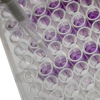
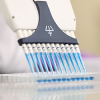
When researchers at Université Paris Cité’s UTCBS lab set out to test a new diagnostic strategy for preeclampsia, they knew their biggest challenge was familiar to many labs: the need for consistency, speed, and precision at scale. Their array-based fluorescent non-targeted sensing approach required analysis of 263 serum samples across more than 16,000 wells. Reaching statistical significance and technical feasibility demanded a precise, consistent, and fast workflow, and manual pipetting was out of the question.
“Without automation, we couldn’t have done it,” said Yvette Zerah, a clinical resident who helped lead the study.
The Research Behind the Workflow
The Chemical Nose Strategy
Within the UTCBS team, Dr. Nathalie Gagey-Eilstein is developing a “chemical nose” platform, which is an alternative to traditional diagnostics. This detection strategy mimics the human olfactory system, enabling the identification and classification of complex mixtures without targeting specific biomarkers.1
“In the array-based chemical nose sensing strategy, the rule is not ‘one single measurement per sample’; it’s ‘a multitude’,” said Dr. Gagey-Eilstein. “What we aim to capture is a comprehensive fingerprint composed of numerous signals”. This pain is counter-balanced since this approach can be easily transposed to a wide range of diseases with relatively little additional effort in the design and synthesis of the sensors. Unlike traditional methods that require the development of specific antibodies and complex biological tools for each target, the Chemical Nose strategy relies on fundamental chemical principles, making it more adaptable. As a result, the potential for broader diagnostic applications is enormous.”
Application to Preeclampsia
Their study aimed to detect preeclampsia before symptoms appeared based on a fluorescent sensor array and machine learning to identify patterns in patient serum.
“We wanted to find another way to diagnose preeclampsia,” Yvette explained. “Something based on how the disease globally affects the serum itself.” Initial experiments with 17 samples showed promise, but the small cohort size limited the strength and broader applicability of the findings. To scale, the team expanded to 263 clinical samples from the APHERESE cohort. That posed a new challenge: how could they reliably prepare and process more than 16,000 wells under multiple conditions and replicates?
Why Automation Was Essential
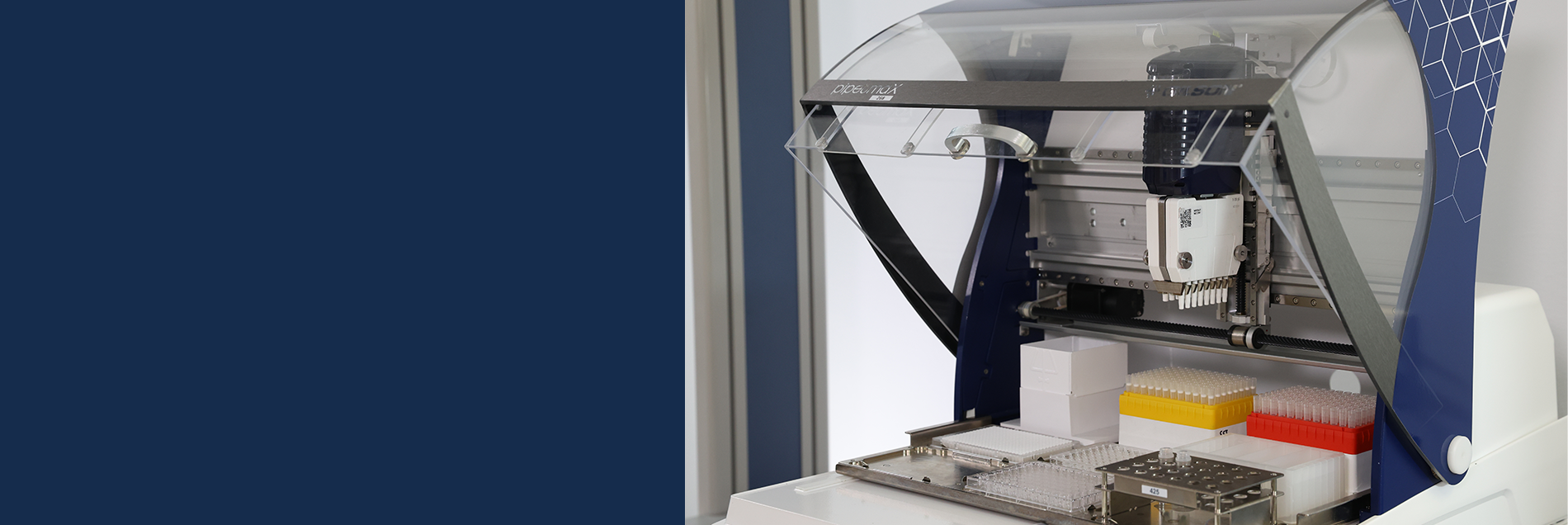
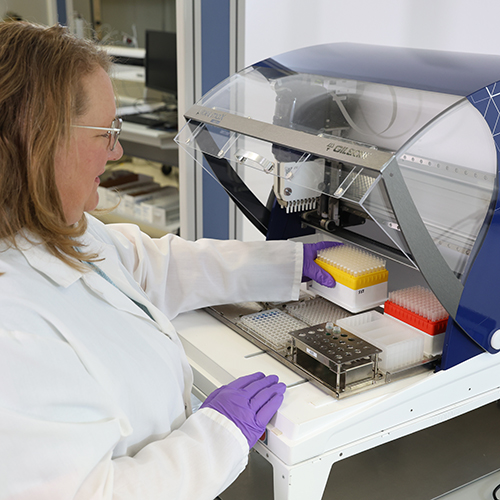
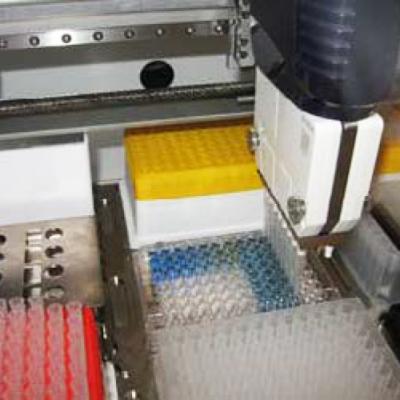
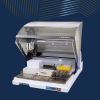
To make the study feasible, the team turned to Gilson’s PIPETMAX® 268, a compact, versatile automated pipetting platform. It quickly became the backbone of the project.
“We considered microfluidics, but it required too much setup and development time,” said Dr. Gagey-Eilstein.2 “PIPETMAX [268] was the only system we found that could handle what we needed: a large range of volumes, consistent transfers, and a flexible deck.”
From day one, the automation delivered a measurable impact:
- Faster throughput – Each 384-well plate was prepared in just 18 minutes.
- Reduced tip consumption – Optimized protocols to cut expected tip use from roughly 16,000 to approximately 2,500.
- Miniaturized experiments and sample conservation – Each sample was just 200 µL, and automation ensured the reliable transfer of 2.5 µL per well without excess loss.
From Bottleneck to Scalable Workflow
PIPETMAX 268 helped the team shift their bottleneck away from sample prep and toward data collection. “The robot made liquid handling one of the fastest steps,” said Yvette. “The longest part ended up being the fluorescence reading."
More importantly, automation allowed them to expand the number of replicates per sample from 6 (in 96-well plates) to 8 (in 384-well plates), boosting reproducibility and statistical strength. This was key to validating their machine learning models, which ultimately achieved robust results across 380,000+ data points, leading to high classification accuracy, validating the chemical nose strategy.
Support That Made the Difference
While PIPETMAX 268 handled the liquid, Gilson’s support team helped bridge the gap when learning how to use a new automation system. “There was definitely a learning curve,” said Yvette. “But the Gilson team helped us figure out how to optimize our protocol, save time, and get the most out of our samples.”
Dr. Gagey-Eilstein agreed: “It requires some training, yes. But once it’s set up and the protocol is running, it improves the manageability of a large experiment like this.”
Advice for Other Labs
For teams considering automation, the researchers offered candid guidance. “You need to know you’re going to use it,” said Dr. Gagey-Eilstein. “If you’re only doing a few plates, it might not be worth the setup. But if your project depends on throughput, then it’s a must-have.”
Yvette added, “It takes time to set up, but it saves so much once you're running.”
Sources:
1 Lavigne et al., Angew. Chem., Int. Ed. 2001 ; Geng, Y. et al., Angew. Chem., Int. Ed. 2019
2 Bosco et al., ACS Applied Biomaterials 2024
Delivering on the Promise of Automation
With the support of Gilson and using PIPETMAX® 268, the UTCBS team streamlined a complex diagnostic workflow and scaled their study to meet the demands of high-throughput analysis. Automation helped reduce manual variability, conserve limited samples, and improve data consistency, strengthening the team's statistical analyses. The workflow is a foundation for future research and potential applications beyond preeclampsia.
AUTOMATE WITH GILSON